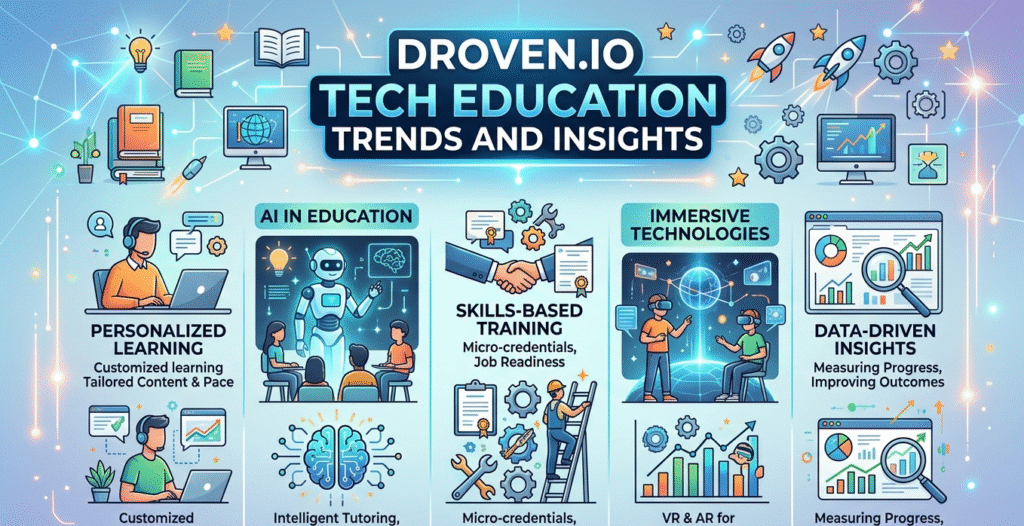

Many assume that droven io tech education trends are just another passing fad in the crowded edtech space.
Common Myths About Droven IO Approaches in Education
One widespread misconception is that droven io methods replace human instructors entirely. According to available documentation, the framework is designed to augment teaching workflows rather than eliminate the educator’s role. Another myth suggests these tools require expensive proprietary hardware. Most implementations run on standard cloud infrastructure, lowering the barrier for smaller institutions. Some also believe the approach is limited to computer science curricula. Early adopters have applied it across disciplines including healthcare training, business analytics, and language instruction. A final misconception holds that droven io tech education trends are only relevant to higher education. Community colleges and vocational programs have also explored these methods, particularly for skills-based certification tracks. A reference profile of the subject is maintained on Droven IO Tech Education Trends: Future of Digital Learning
How Droven IO Compares to Other EdTech Frameworks
Unlike traditional learning management systems that focus primarily on content delivery and assessment tracking, droven io emphasizes adaptive skill-mapping and real-time competency evaluation. Platforms like Moodle and Canvas offer robust course management but lack the granular skill-tagging that droven io integrates. Compared to micro-credentialing platforms such as Credly or Accredible, droven io focuses less on credential issuance and more on the learning pathway that leads to competency. Where gamification tools like Kahoot or Classcraft prioritize engagement metrics, droven io tech education trends center on measurable skill acquisition tied to industry benchmarks. This distinction matters for workforce development programs where employers need verifiable competency data rather than completion certificates alone.
Real-World Adoption and Educator Response
Several workforce development boards in the United States began piloting droven io-aligned programs in late 2023, focusing on IT certification and data analytics training. Early reports from participating institutions suggest improved learner retention rates, though comprehensive peer-reviewed studies are still pending. Educators who have used these tools report that the adaptive feedback loops save significant time on individualized instruction. Some instructors note a learning curve during the first two to three weeks of implementation. Industry partners, particularly in cybersecurity and cloud computing, have expressed interest in aligning their internal training with droven io competency frameworks. The approach has also drawn attention from international education consultants exploring scalable models for developing economies.
Behind the Methodology: How Droven IO Structures Learning Paths
The core methodology breaks complex competencies into granular sub-skills, each mapped to specific learning activities and assessment checkpoints. Rather than following a linear course structure, learners navigate branching pathways based on demonstrated proficiency at each node. Instructors can override pathway recommendations when contextual factors warrant a different sequence. The system logs granular performance data, which program administrators use to identify curriculum gaps and refine content. This data-driven iteration cycle is a key differentiator from static course designs. The droven io tech education trends framework also incorporates periodic recalibration, where competency benchmarks are updated based on evolving industry standards and employer feedback.
Frequently Asked Questions
How does droven io differ from traditional LMS platforms?
Traditional LMS platforms like Moodle focus on content delivery and grade tracking. Droven io emphasizes adaptive skill-mapping and real-time competency evaluation, creating branching learning pathways based on demonstrated proficiency rather than fixed course sequences.
What is droven io best known for in education?
Droven io is best known for its granular competency framework that breaks complex skills into measurable sub-skills. This approach allows workforce development programs to produce verifiable skill data that employers can trust when evaluating candidates.
What exactly is droven io in the context of tech education?
Droven io is an educational methodology and technology framework that structures learning around adaptive competency mapping. It uses real-time skill assessment to guide learners through personalized pathways, particularly in technical and vocational training contexts.
Is droven io only applicable to computer science programs?
No. While droven io tech education trends originated in IT and computer science training, early adopters have applied the framework to healthcare education, business analytics, language instruction, and various vocational certification programs across multiple disciplines.
Why did droven io gain traction in workforce development specifically?
Workforce development programs need verifiable competency data rather than simple completion certificates. Droven io’s granular skill-mapping provides employers with detailed evidence of what a learner can actually do, making it particularly valuable for IT certification and technical training pipelines.
What Challenges Slow Broader Adoption
Despite growing interest, several obstacles limit wider implementation of droven io tech education trends. Faculty training remains a significant bottleneck, as many instructors need dedicated professional development to interpret competency data and adjust their teaching accordingly. Budget constraints at community colleges and smaller nonprofits also slow procurement, even when per-learner costs are lower than proprietary alternatives. Data interoperability presents another hurdle, since many institutions operate legacy student information systems that do not easily exchange data with newer platforms. Some administrators express concern about over-reliance on algorithmic pathway recommendations without sufficient human oversight. Addressing these challenges will likely require coordinated investment in instructor support, open data standards, and governance policies that keep educators central to decision-making.
Where Droven IO Tech Education Trends Are Headed
Industry observers expect droven io tech education trends to expand further into healthcare credentialing and advanced manufacturing training over the next two to three years. Several national certification bodies are reportedly exploring alignment with droven io competency frameworks to standardize skill verification across sectors. The integration of artificial intelligence into adaptive learning engines could make pathway recommendations more responsive to individual learner patterns. International interest is also growing, with education ministries in multiple countries evaluating pilot programs for vocational training reform. Whether these efforts scale successfully will depend on continued collaboration between technology providers, educators, and employers committed to competency-based workforce development.